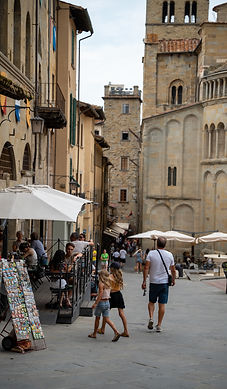
Arezzo
The first city we visited was the beautiful Arezzo. Already at the turn off the highway, it is recognizable on a small hill as an old town with a cathedral in the center, which is also the case in almost all old towns in Italy.
We parked on a side street with the intention of exploring the place properly and not using the map too much.
The road first led us through a huge park where we met mostly locals who came for a walk after a working day, for a coffee at a nearby cafe or took their children to the playground within the park.
Continuing on, we slowly reached the center of the old town, which amazed us at first sight.Since that it was the first day of the tour, everything caught our attention, especially the cathedrals, old buildings with yellow and stone facades, green shutters and small terraces decorated with flowers.


Moreover, while wandering the streets, we came across many local handmade shops, cafes, bakeries and souvenir shops. My favorites are shops with jewelry, homemade spices and paste, as well as shops with home decor.


There wasn't the end. We came across the huge park on the top of the city known as Parco II Prato, where we drink our first espresso coffee in the small cafe. Walking uphill through this park you can reach to the historic site, and downhill is again the center of the city where you can reach to Arezzo Cathedral.


The Cathedral of Arezzo, dedicated to St. Peter and St. Donatus, main Catholic place of worship is located atop the hill of San Pietro, in the upper part of the city, across the Piazza del Duomo and on the site of an early Christian church. Initially, the first cathedral of Arezzo stood on the nearby Colle del Pionta, on the place where the holy martyr Donatus was buried and venerated, but in 1203 Pope Innocent III ordered Bishop Amedeo to transfer it within the city walls and has a huge history of renovations where any mason left a distinguish mark. The Cathedral has a Gothic Architecture style and was built from 1278 - 1914.


The Cathedral of Arezzo is still dedicated to San Donato and preserves on the main altar a valuable fourteenth-century marble ark dedicated to him where the body of the saint is preserved.
The interior, with a nave and two side aisles but no transept, has five bays separated by clustered piers and a polygonal apse. The superb cycle of seven stained-glass windows was painted by Guillaume de Marcillat in two stages between 1516 and 1524.
The high point of the cathedral is the Chapel of the Madonna of Consolation.
Inside the chapel are numbers of Della Robbia glazed terracotta works brought from other churches in Arezzo and placed here in honor of the Virgin Mary in 1811.


Serre Di Rapolano
After lunch and a short rest, we decided to continue our tour and came across the next hilltop village of Serre Di Rapolano.
Serre di Rapolano was born as a castle in the Byzantine era and maintained this function even during the Lombard domination and in the Middle Ages.
From the west entrance to the town, we came across Museo dell'Antica Grancia e dell'Olio. This 13th century building hosts a museum that documents the history of the ancient, fortified granaries belonging to the Hospital of Santa Maria della Scala in Sienna and the ancient working process of producing wine and olive oil.


Serre Di Rapolano is a characteristic small hilltop village surrounded by walls. Among peculiarities of this area are the travertine quarries. Travertine is a form of limestone deposited by mineral springs and it is used as a construction material in many buildings of the village.
This place is part of a municipality of Rapolano Terme, known for its hot springs, which is the place where you can relax after long walking during visiting nearby places.


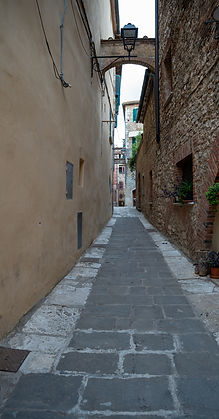

This place led us to magical streets decorated with flowers, as well as decorative flowerpots and a variety of entrance doors that we were obsessed with throughout the trip.


In addition to walking through these streets, we came across a lookout point that especially delighted Milos, who took advantage of this opportunity to fly a drone to record the sunset.


Monte San Savino
Monte San Savino is a town and comune in the province of Arezzo. It originated around 1100, but after one more century Monte San Savino could be considered a center of a certain social, political and cultural importance of Tuscany in those times. Today, this town has a population of around 8,000 residents.
The town is known for its well-preserved medieval architecture, including the Palazzo Comunale, a beautiful town hall dating back to the 14th century, and Romanesque church, the Church of San Giovanni Battista, as well.


We heard that Monte San Savino has a rich artistic heritage, with numerous art galleries and studios showcasing the work of local artists. The town also hosts an annual art exhibition, gathering artists and art enthusiasts from around the region. They host a variety of cultural events and festivals as well, celebrating music, art, and local traditions. One of the most popular is the Palio dei Somari, a donkey race that takes place in the historic center of the town.
Walking through the streets of the town it is possible to stop in the local gelaterias and small workshops to buy some souvenirs.